Fortress AI
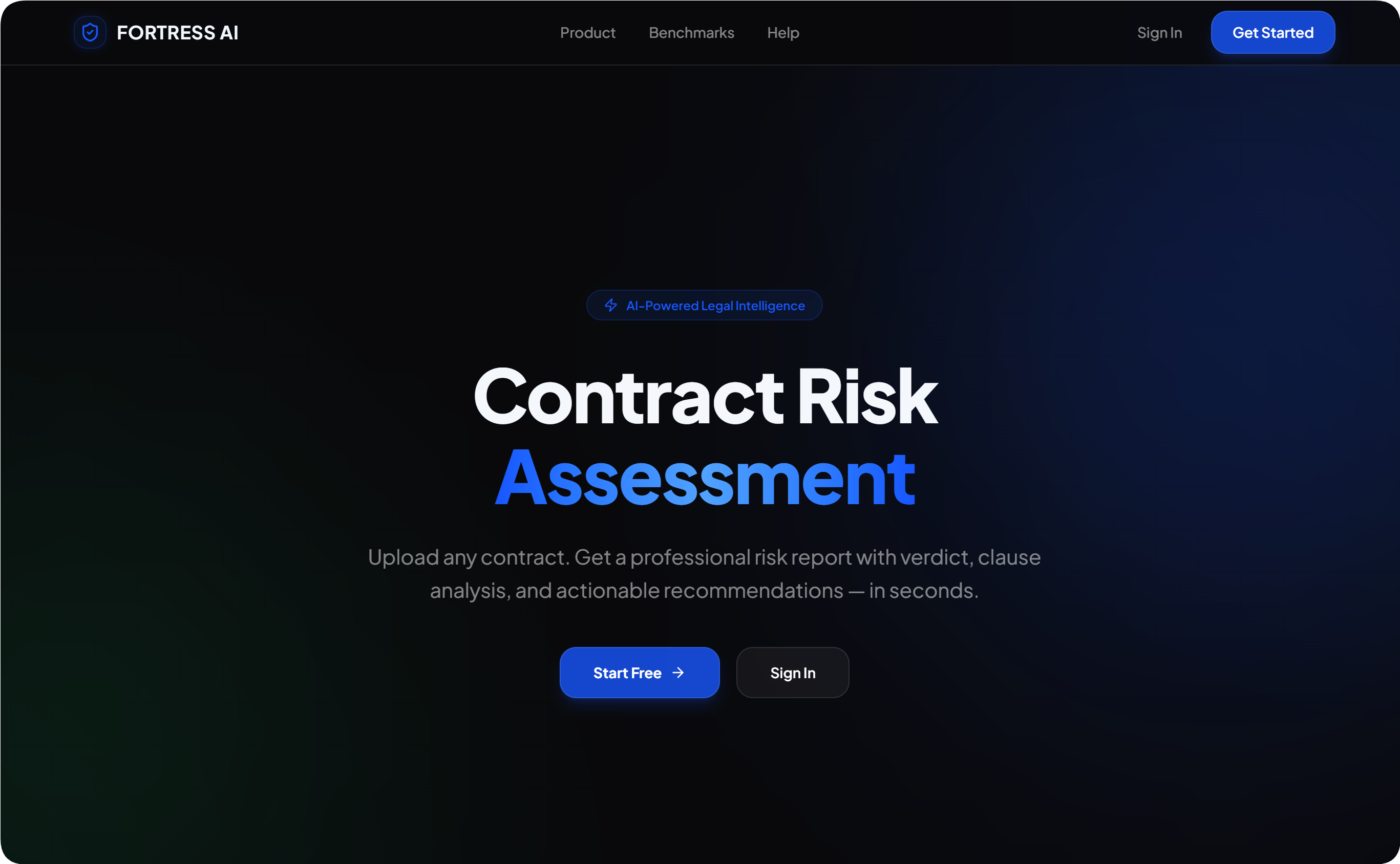
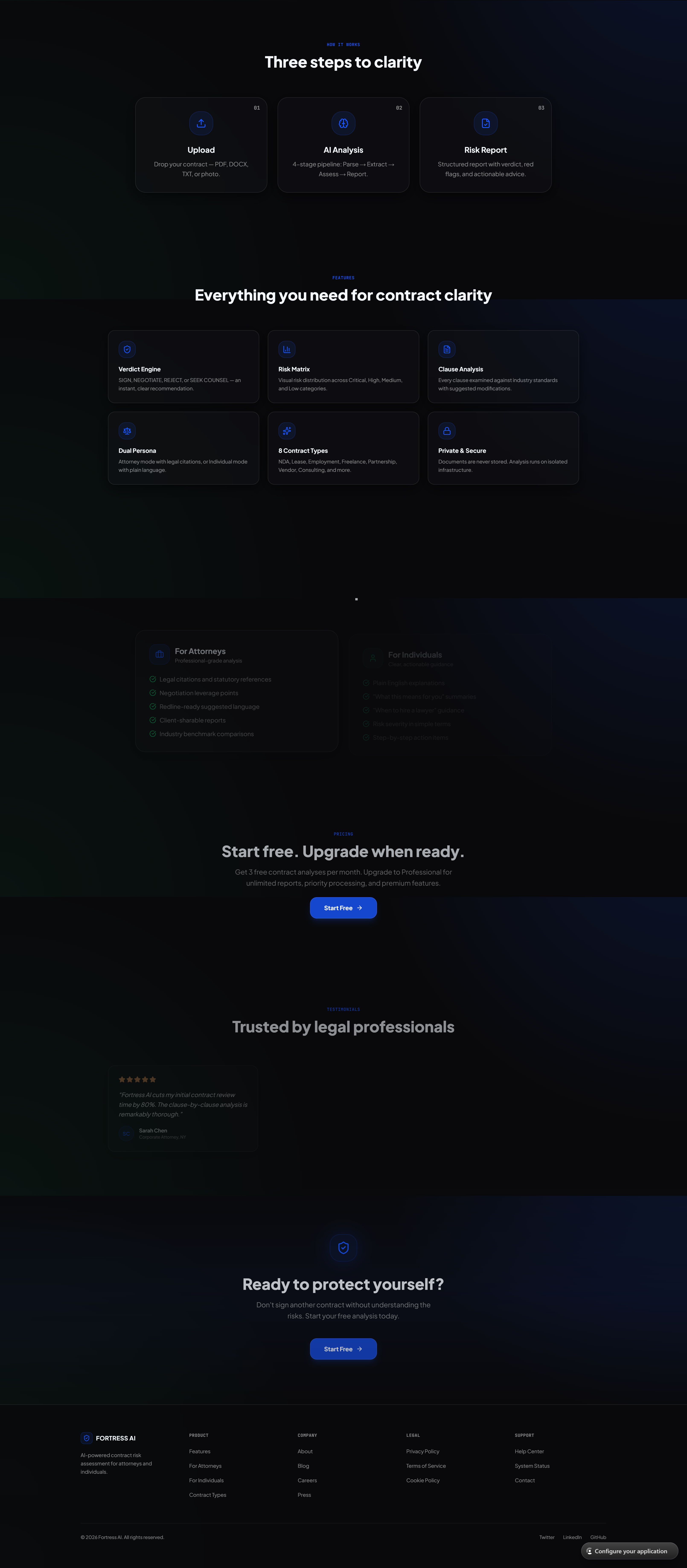
A full stack multi-agent legal audit system built to run on AMD MI300X GPU clusters. Fortress AI is a secure "Command Center" for complex legal document analysis combining LangGraph agent orchestration, ROCm-accelerated vLLM (Qwen) inference, semantic vector search via Qdrant, and a Next.js front-end to let legal teams run parallel, deep-dive audits across large document corpora. Built as part of a small team, my contributions focused on the backend AI engineering components — section by section document analysis pipeline, FastAPI integration, reliability testing, and frontend modifications to align with the analysis workflow.
Screenshots
Problem Statement
The Problem
Legal document review is one of the most expensive and bottlenecked workflows in any organization. Contracts, compliance filings, and audit trails run into hundreds of pages. A single legal professional can spend days manually cross-referencing clauses, obligations, and risk flags across a document corpus, work that is repetitive, error-prone, and does not scale.
Existing AI legal tools are single-pass summarizers. They read a document and return a flat summary. They cannot reason across multiple documents simultaneously, maintain context between analysis stages, or run parallel specialized agents that each focus on a distinct legal dimension, liability, compliance, IP, or jurisdiction and then synthesize their findings.
The deeper problem was infrastructure: running capable open-weight models locally for sensitive legal work required GPU clusters that most tools were not designed to target. There was no production-ready multi-agent legal audit system built specifically to take advantage of AMD MI300X server-grade hardware.
Solution
The Architecture
Fortress AI is built as a LangGraph multi-agent graph where each node is a specialized legal reasoning agent. Documents are ingested through a FastAPI backend, chunked, and embedded into a Qdrant vector database for semantic retrieval. When an audit is triggered, the orchestrator dispatches parallel agents, each targeting a specific legal dimension, that retrieve relevant chunks, run inference via vLLM serving Qwen on ROCm-accelerated MI300X hardware, and return structured findings.
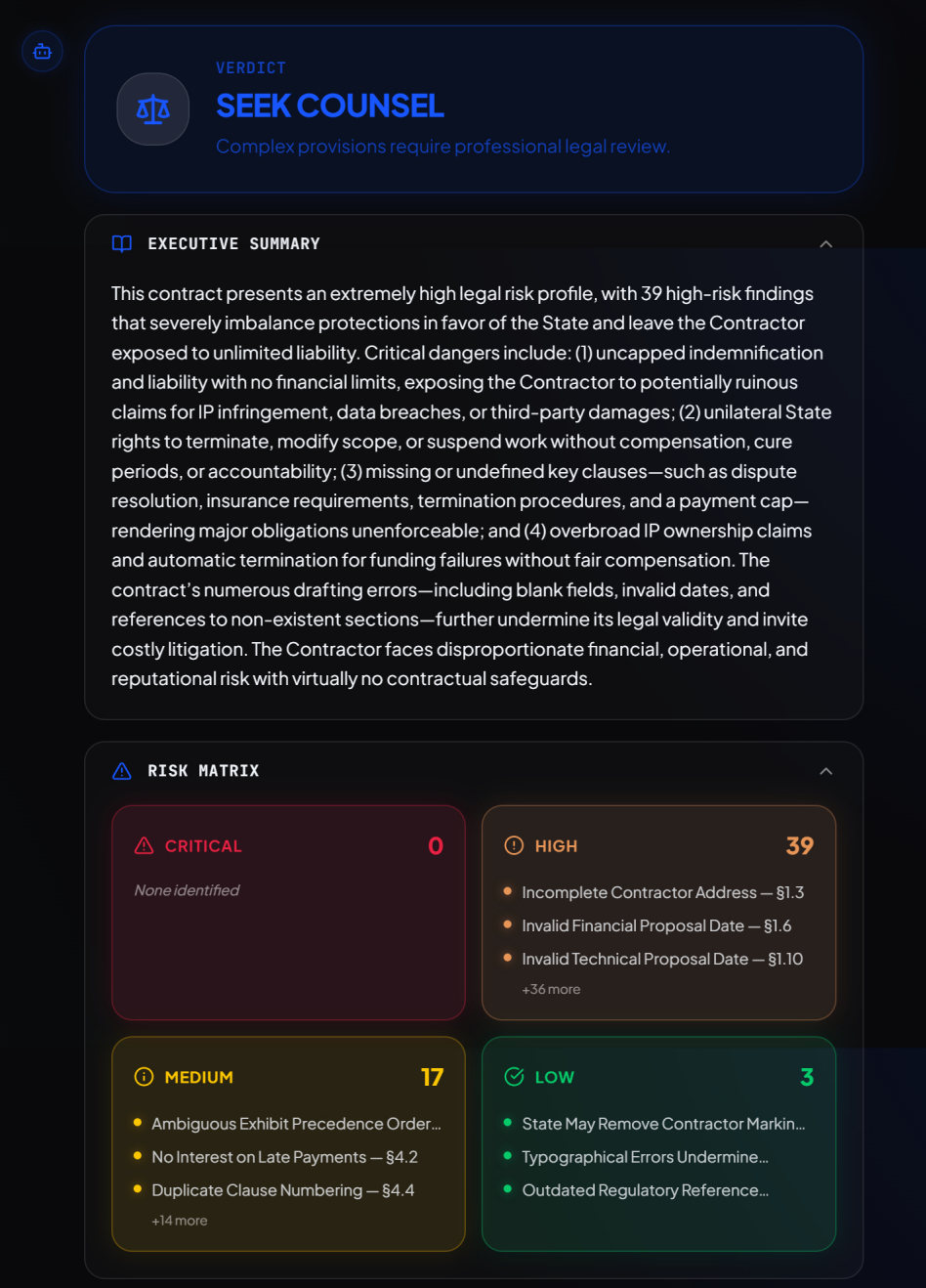
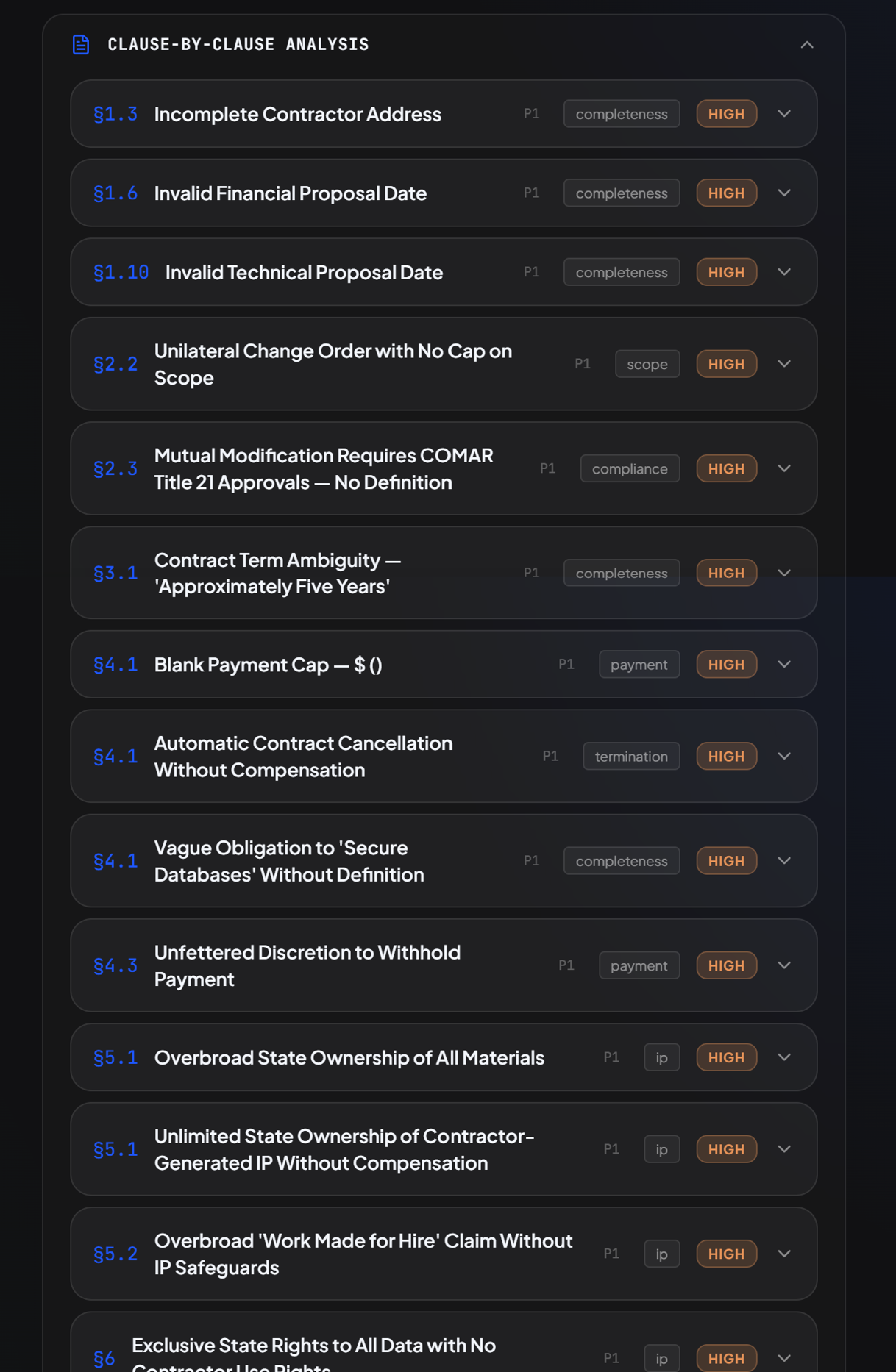
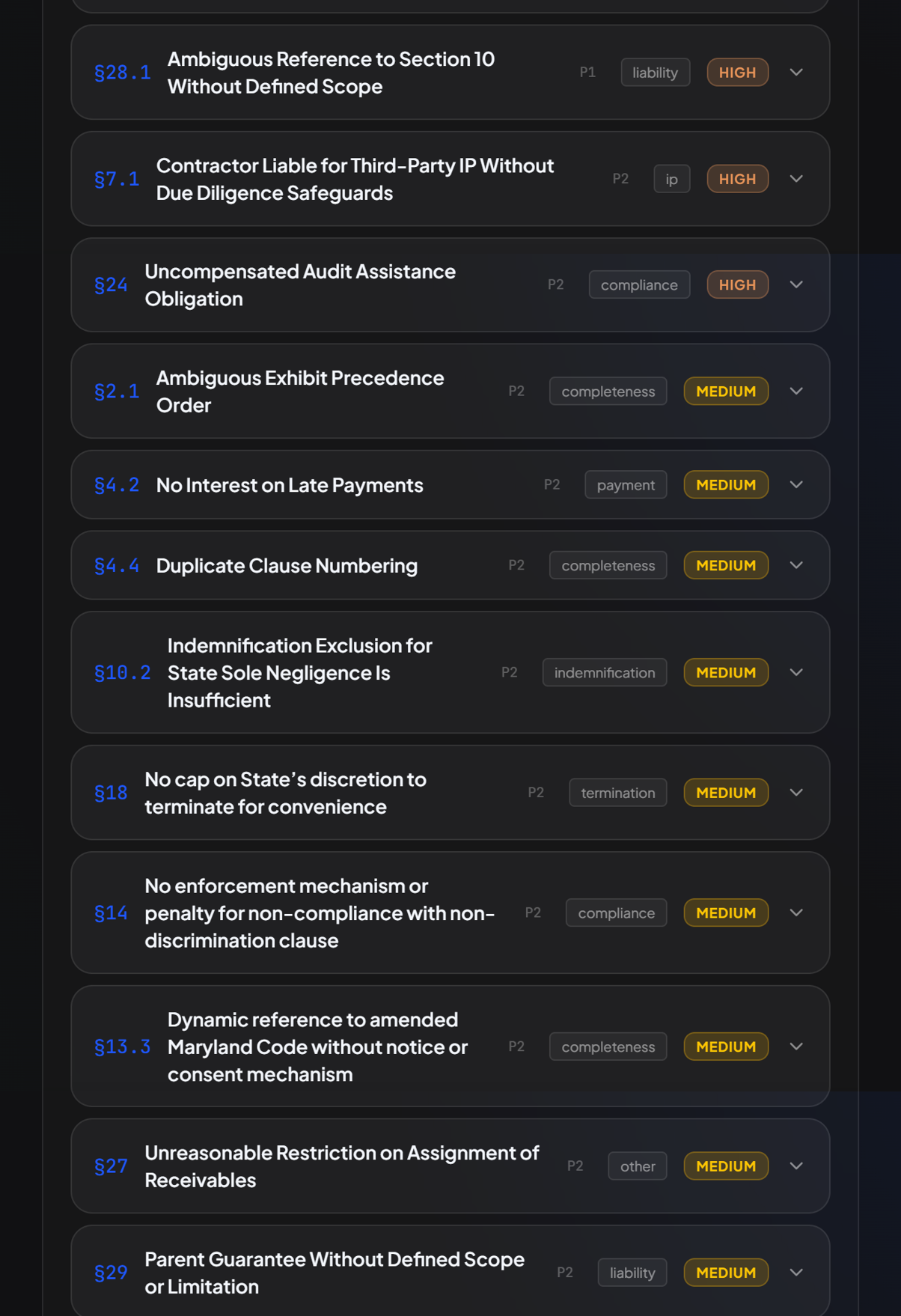
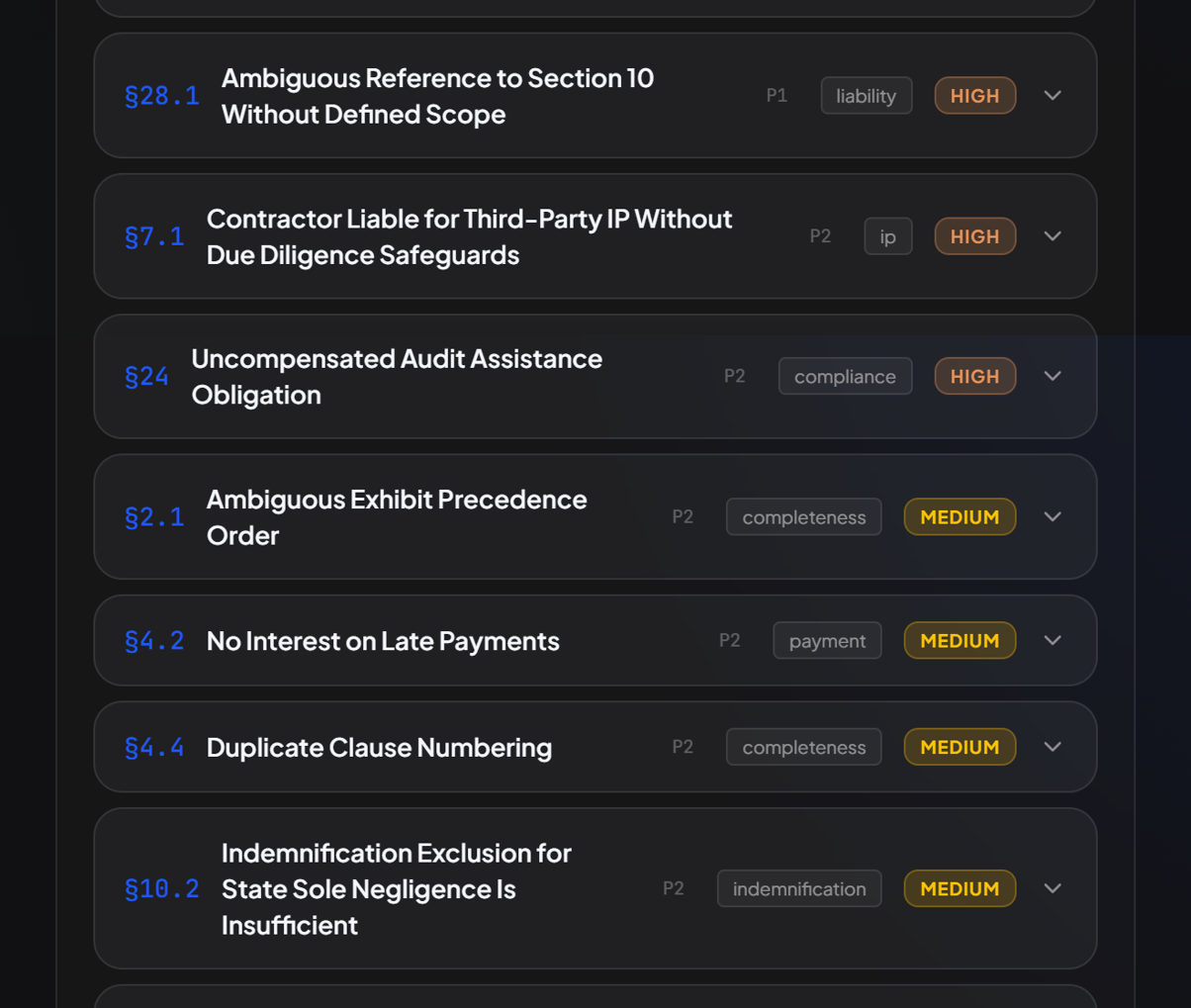
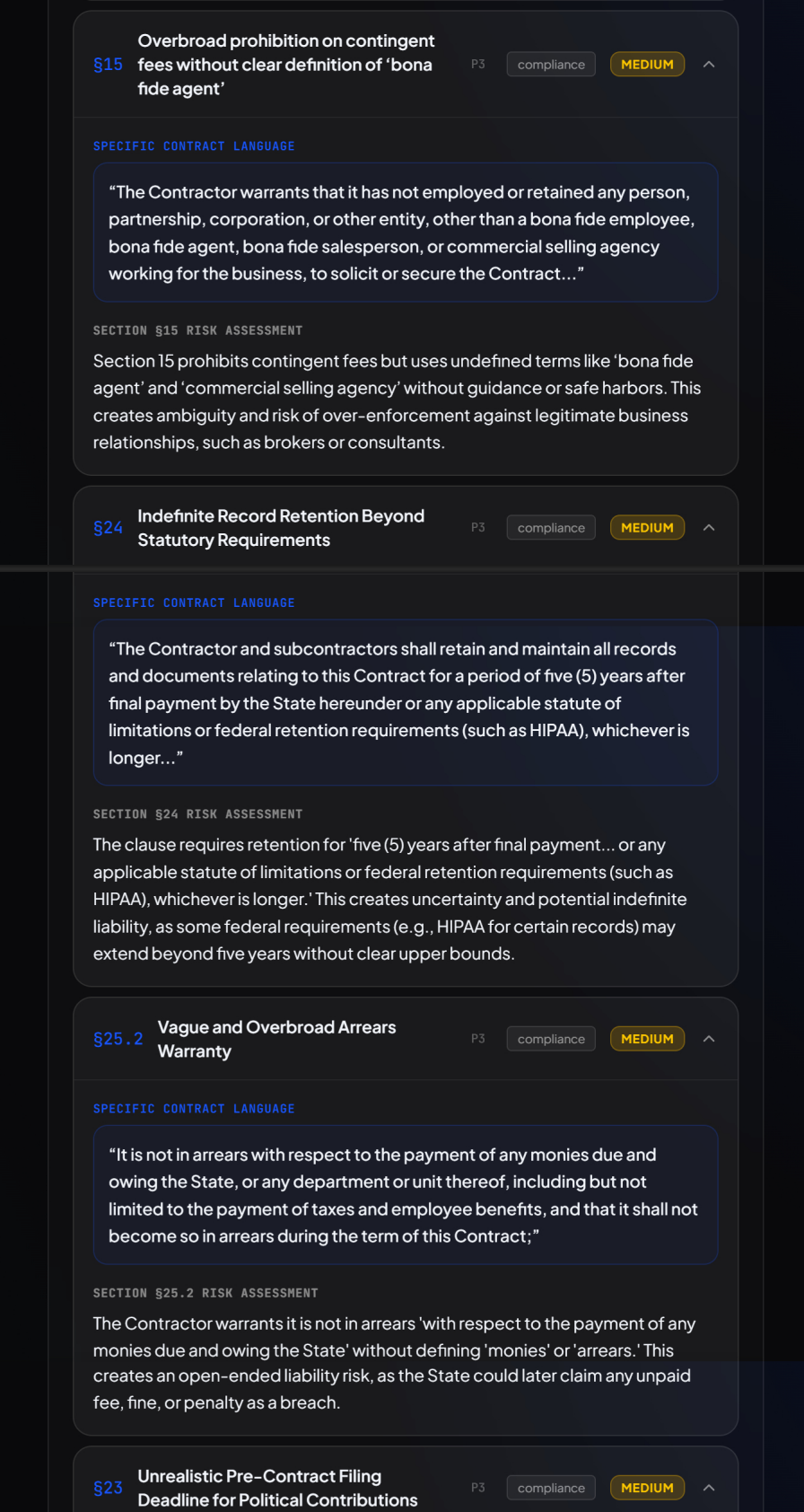
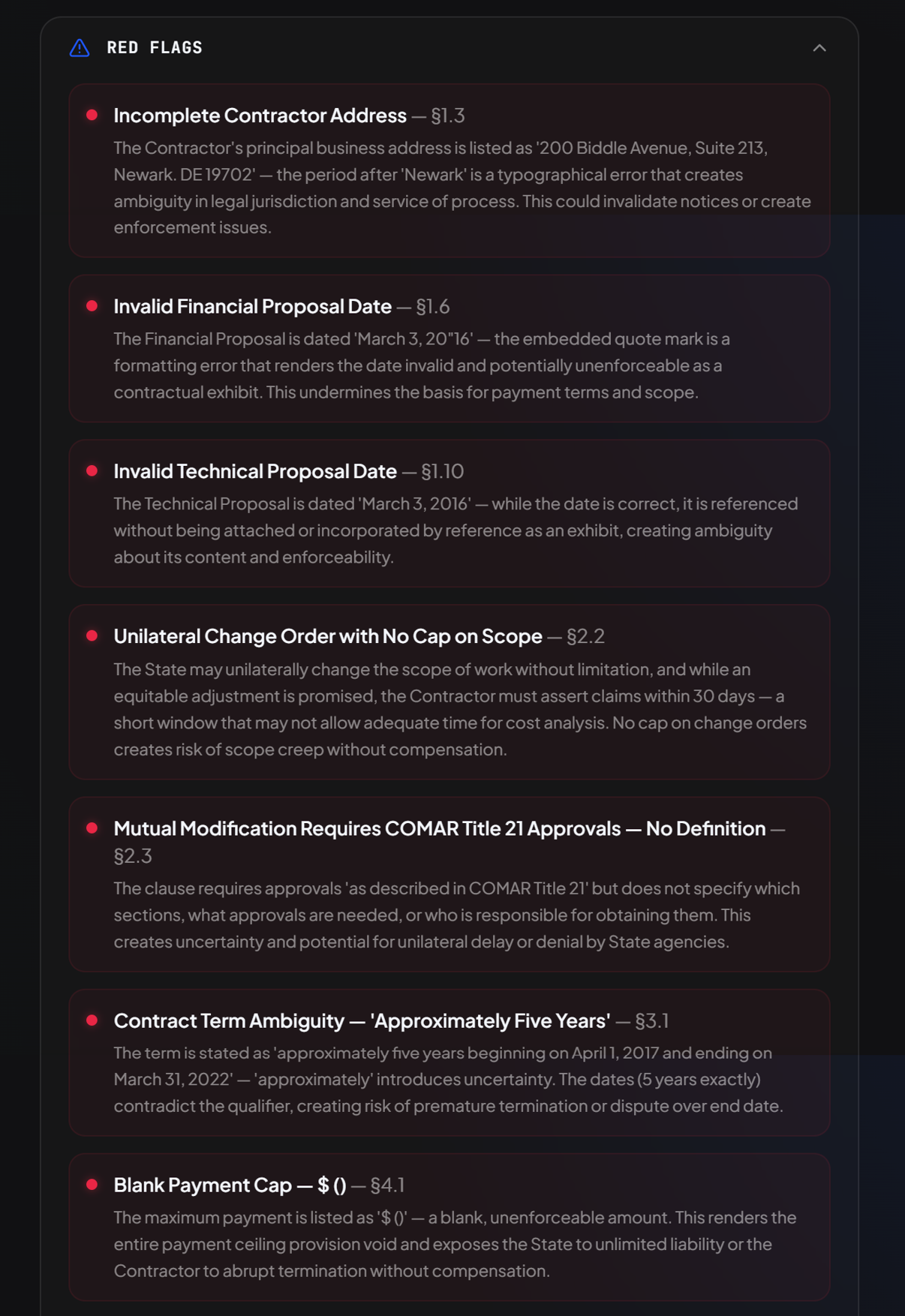
Structured findings from each agent are persisted to PostgreSQL via Prisma and surfaced through the Next.js "Command Center" UI. The frontend renders per-agent verdict cards, clause-level risk flags, and a final synthesized audit report that aggregates all agent outputs into a single actionable document.
- FastAPI backend handles document ingestion, chunking, embedding, and agent dispatch.
- LangGraph defines the agent orchestration graph — parallel fan-out, structured reduce, conditional routing.
- vLLM serves Qwen over ROCm on AMD MI300X clusters for local, secure, high-throughput inference.
- Qdrant stores document embeddings and handles dense vector retrieval per agent query.
- PostgreSQL via Prisma persists audit sessions, agent findings, and user history.
- Next.js Command Center provides the interactive audit UI, verdict cards, and export.
- Docker containerizes the full stack for reproducible deployment on AMD server hardware.
Known Limitations
Known Limitations
Fortress AI was built under a hackathon deadline. Several architectural gaps are worth being direct about.
- Embedding and retrieval is not incremental. Re-ingesting a document that was already processed re-embeds the entire file rather than diffing changed chunks. At scale, this adds unnecessary compute cost on repeated uploads of updated contracts.
- Agent context windows are not shared. Each LangGraph agent starts with its own retrieved chunks and does not have access to findings from sibling agents mid-run. Cross-agent reasoning only happens in the final synthesis step, which limits the depth of inter-dimension analysis.
- There is no streaming output from agents to the UI. The Command Center waits for all agents to complete before rendering results, so large document sets produce a long blank waiting period with no incremental feedback.
- The vLLM server is stateless between requests, there is no KV-cache reuse across audit runs on the same document set, which means repeated queries over the same corpus re-run full prefill passes.
What's Next
What's Next
The known limitations map directly onto the v2 roadmap.
Incremental embedding would replace full re-ingestion on document updates. A content-hash diff layer would identify changed chunks and only re-embed those, cutting re-processing cost significantly for large contract libraries that receive frequent amendments.
Shared agent memory would let sibling agents read each other's partial findings mid-run through a shared working memory node in the LangGraph graph. This would enable cross-dimension reasoning — a liability agent flagging a clause that the compliance agent has already marked — before the synthesis step.
Server-sent events from FastAPI through to the Next.js frontend would replace the current all-or-nothing result delivery. Agents would stream individual findings as they complete, giving users real-time progress visibility on long audit runs.
Persistent KV-cache prefixes on the vLLM server for frequently audited document sets would eliminate redundant prefill passes, reducing time-to-first-token on repeated queries over the same corpus.
Sponsors
 AMD